All published articles of this journal are available on ScienceDirect.

The Influence of Traditional Birth Attendants’ Spirituality on Their Decision-Making and Health Management Practices in Maternal and Child Health: A Scoping Review

Abstract
Introduction
Although vast literature exists on the role of traditional birth attendants (TBAs) within child and maternal health, very little is known about what informs their healthcare management approach, practices, and decision-making therein. Previous studies, predominantly within Sub-Saharan Africa, have shown that women prefer the care of TBAs, which, in comparison to medical health facilities, is reported as being holistic, spiritually informed, culturally competent, and respectful. Even so, there is a dearth of research on the influence of spirituality on TBA’s decision-making and healthcare management practices within the area of child and maternal health.
Methods and Analysis
This scoping review followed the PRISMA-Scr guidelines. The authors used CADIMA to manage the search, screening, and data extraction processes. The relevant articles were analyzed using content analysis, and the results are presented in a descriptive format, using charts, themes, and illustrative quotes.
Results
The database search retrieved 226 eligible articles. From these, only 28 studies met the inclusion criteria and were included for data extraction. The results are synthesised and reported under three themes.
Discussion
Despite a lack of shared definition, the evidence revealed that spirituality is integral to TBAs' management of maternal and child health and underpins their decision-making in this context.
Conclusion
There is a need for further research to establish a clear operational definition of spirituality when investigating its role in TBAs' decision-making and health management practices in maternal and child health.
1. INTRODUCTION AND BACKGROUND
Traditional Birth Attendant (TBA) refers to “a person who assists the mother during childbirth, and initially acquired her skills by delivering babies herself, or through apprenticeship to other TBA’s” [1]. Although the above definition focuses on childbirth, TBAs are involved throughout the stages of the pregnancy, including during childbirth and the post-natal phase, and support maternal and child health and wellbeing. In 1987, the United Nations launched the Safe Motherhood Initiative to ensure safe pregnancy and motherhood, and supported the presence of trained birth assistants as an indication of the programme’s success. Although the maternal mortality ratio (MMR) has decreased by 38% globally, sub-Saharan Africa still reports the greatest amount of MMR to date [2].
Despite the measures put in place by the World Health Organization to reduce the maternal mortality rate (MMR), many women within sub-Saharan Africa continue to prefer home births with TBA’s who generally do not have formal training. One key reason that emerges across the literature is women’s preference for the TBAs’ cultural constructs of care, experienced as holistic, non-judgemental, warm, and kind. In South Africa, these qualities, approaches and practices are informed by TBAs’ cultural and spiritual worldviews [1], highlighting the multi-faceted relationship between spirituality and health management. Spirituality is deeply personal, and one’s understanding of spirituality influences the thoughts and actions of the individual who practices it. There are various definitions of spirituality, which makes the concept challenging to define [3-5]. Spirituality is broader than religion and is often perceived as a personal journey [6]. For purposes of this review, spirituality is broadly framed as the connection to the Divine, self, and Others, and a way individuals seek and express meaning and purpose [7, 8].
The World Health Organization recognizes the importance of spiritual care as a component and determinant of health [9, 10]. In fact, the provision of healthcare is regarded as a “spiritual activity” [11], which offers compassionate care to the whole person, including “physical, emotional, social, and spiritual” dimensions. Many studies have also explored the relevance and impact of spirituality on one’s health and decision-making [12-14]. Evidence shows the positive impact of spirituality within the healthcare process [8] and leadership, both as managers and patients [6, 12]. Even so, spirituality remains absent from health professionals’ training and education, and TBA’s remain excluded from the formal health system. This dynamic creates tension(s) within healthcare systems, in which spirituality is acknowledged as a determinant of health, yet the knowledge, practices, and actors associated with spiritual care remain insufficiently integrated into mainstream healthcare provision. Further to this, there is limited research on the role of spirituality in the health management and decision-making processes used by TBAs, which inform their values, beliefs, decisions, and subsequent health management practices in child and maternal health [15]. Such data holds potential to offer a more nuanced understanding of TBAs' spirituality and the role it plays in their decision-making and health management of expectant women. Mapping the scope of evidence on this topic may inform efforts to address the exclusion of TBAs from the health sector, and may inform inclusive strategies for holistic healthcare management, mutual learning, better collaboration, and ultimately improved MMR.
1.1. Research Question(s)
1.1.1. Main Question
What is the scope of evidence on the influence of spirituality on traditional birth attendants’ decision-making and health management practices within child and maternal health?
1.1.2. Sub-question
What are the spiritual guidelines, knowledge(s), systems, and/or beliefs that inform TBAs decision-making and health management practices within child and maternal health?
1.1.3. Objectives
- To map the breadth of literature on the influence of spirituality on traditional birth attendants’ decision-making and health management practices within child and maternal health.
- To identify the types and range of evidence available on the influence of spirituality on traditional birth attendants’ decision-making and health management practices within child and maternal health.
- To clarify key concepts and identify knowledge gaps on the influence of spirituality on traditional birth attendants’ decision-making and health management practices within child and maternal health.
2. METHODS
2.1. Study Design
This study employed a scoping review design and followed the Preferred Reporting Items for Systematic Reviews and Meta-Analysis extension for Scoping Reviews (PRISMA-ScR) reporting guidelines and checklist (https://www.prisma-statement.org/scoping). The PRISMA-ScR outlines the following steps when conducting a scoping review 1) Protocol development and registration, 2) Identification of the eligibility criteria, 3) Description of information sources, 4) Description of the search strategy, 5) Selection of sources of evidence (screening and eligibility 6) Data extraction and charting, 7) Synthesis of results, and 8) Reporting, which includes a summary of evidence, study limitations and conclusion.
2.2. Protocol and Registration
The protocol for this study was registered on the Open Science Framework (OSF) site on the 16th of April 2025 and can be found at: https://doi.org/10.17605/OSF.IO/2CYQ5.
The registration occurred before the database searches conducted on the 5th of May 2025.
2.3. Eligibility Criteria
2.3.1. Population
The population of this scoping review is Traditional Birth Attendants (TBA) who provide services within the scope of child and maternal health. No restrictions were placed on age, gender, or geographical location, as the aim was to explore the literature comprehensively.
2.3.2. Concept
This study focuses on the concept of spirituality and the role it plays in TBAs’ health management practices when providing maternal and child healthcare services.
2.3.3. Concept
Although a part of health management, we have identified decision-making as a concept that may occur within or outside of the context of health management.
2.4. Information Sources
The following databases (Table 1) were searched to identify peer-reviewed literature and grey literature. A search for grey literature was conducted through searching non-traditional publishing channels such as online repositories. These data sources potentially contain detailed research and evidence that may be unavailable in peer-reviewed journals. We selected databases that addressed health and social sciences research. These were selected as they were the most likely to address the topic of the study.
| Search String | Database or Further Sources | Results | Date |
|---|---|---|---|
| (“traditional birth attendant” OR “indigenous midwi*” OR doula*) AND (spiritual* OR “cultural construct of care” OR “spiritual belie*” OR “spiritual values” OR “spiritual guideline” OR “traditional value” OR “indigenous knowledge” OR spiritism OR metaphysical OR sacred) | EBSCOhost | 28 | 2025-05-05 |
| (“traditional birth attendant” OR “indigenous midwi*” OR doula*) AND (spiritual* OR “cultural construct of care” OR “spiritual belie*” OR “spiritual values” OR “spiritual guideline” OR “traditional value” OR “indigenous knowledge” OR spiritism OR metaphysical OR sacred) | PubMed | 151 | 2025-05-05 |
| (“traditional birth attendant” OR “indigenous midwi*” OR doula*) AND (spiritual* OR “cultural construct of care” OR “spiritual belie*” OR “spiritual values” OR “spiritual guideline” OR “traditional value” OR “indigenous knowledge” OR spiritism OR metaphysical OR sacred) | Scopus | 97 | 2025-05-05 |
| (“traditional birth attendant” OR “indigenous midwi*” OR doula*) AND (spiritual* OR “cultural construct of care” OR “spiritual belie*” OR “spiritual values” OR “spiritual guideline” OR “traditional value” OR “indigenous knowledge” OR spiritism OR metaphysical OR sacred) | Web of Science | 31 | 2025-05-05 |
| (“traditional birth attendant” OR “indigenous midwi*” OR doula*) AND (spiritual* OR “cultural construct of care” OR “spiritual belie*” OR “spiritual values” OR “spiritual guideline” OR “traditional value” OR “indigenous knowledge” OR spiritism OR metaphysical OR sacred) | ProQuest | 4 | 2025-05-05 |
2.5. Search
The search strategy was an iterative process; this allowed us to refine the search terms based on initial results. In addition, the authors carried out the searches independently at first and then consulted with library support staff to ensure the effectiveness of the search strategy.
2.5.1. Query Strings
(“traditional birth attendant” OR “indigenous midwife” OR doula) AND (spirituality OR “cultural construct of care” OR “spiritual belief” OR “spiritual values” OR “spiritual guideline” OR “traditional value” OR “indigenous knowledge” OR spiritism OR metaphysical OR sacred) AND (“decision making” OR “cognitive process” OR “problem solving”) AND (“health management” OR “health care practice” OR “health system” OR “health service” OR “healthcare management”)
During the database searches (Table 1), it was found that including the terms “decision-making” and “health management” narrowed the results and, in some cases, yielded none. With assistance from the library staff, it was advised to exclude the terms as they unduly restricted the search results. Amendments were made to the search string using truncated terms to facilitate the identification of a broad range of relevant evidence. The final search string is presented below.
2.5.2. Final Query String
(“traditional birth attendant” OR “indigenous midwi*” OR doula*) AND (spiritual* OR “cultural construct of care” OR “spiritual belie*” OR “spiritual values” OR “spiritual guideline” OR “traditional value” OR “indigenous knowledge” OR spiritism OR metaphysical OR sacred).
2.5.3. Keywords and Search Terms
Keywords from a preliminary search of the literature were identified. This assisted in identifying synonyms and alternative phrasing of the key concepts. In addition, we searched for synonyms for the key concepts. These were included in the query strings to allow us to identify relevant studies that may use varying terminology.
2.5.4. Search Operators and Syntax
The study used the Boolean operators ‘AND’, ‘OR’, and inverted commas to help us search for as many variations of the key concepts as possible, and to identify relevant literature specific to the topic that might use alternative phrasing. We did not use ‘NOT’ as our objective was to ascertain the scope and the breadth of relevant literature, without excluding any specific terms that may further limit the search. For the final search string, we used wildcard syntax to act as placeholders for unknown or variable characters. This allowed us to search for multiple variations of key concepts without having to type every possible option.
2.6. Selection of Sources of Evidence
2.6.1. Screening
The reviewers used CADIMA, a free web-based tool to facilitate and document the screening, selection, and data extraction processes. The use of CADIMA allowed for the collection and uploading of the database search results, automated duplicate removal, remote teamwork, collaboration, and inter-reviewer agreement. Screening was performed by each author at two levels, using CADIMA. Firstly, screening the title and abstract to remove obviously irrelevant literature; secondly, screening the full text to examine compliance with the eligibility criteria. Documents were then categorized as included, excluded, or uncertain. Reasons for the exclusion of literature were documented, and those labelled as uncertain were revisited after a discussion between the reviewers to agree on the publication’s relevance and therefore inclusion or exclusion in the review process.
2.6.2. Used Exclusion Criteria
Language: Any relevant literature in another language besides English will be excluded.
2.6.3. Screening Reliability and Reconciliation Procedure
CADIMA allows for multiple team members to review the search results, and facilitates opportunities for inter-reviewer discussion, agreement, and decision-making. Each author reviewed independently and documented their reasons for exclusion. We worked very closely together when screening the results. The first author was notified by CADIMA of any discrepancies between the reviewers' screening results. A meeting was then arranged with the second author to discuss and resolve any discrepancies and any items identified as ‘uncertain’.
2.7. Data Charting Process
2.7.1. Data Extraction
CADIMA facilitates the creation of a data extraction sheet from the key components of the study. The generated data extraction sheet was piloted on five studies, allowing for refinement of the identified categories, and ensured that all relevant data were extracted. The data extraction process outlined is informed by the updated methodological guidance for conducting a JBI scoping review [16] (Table 2).
| 1 | We piloted the generated data extraction spreadsheet, using five studies. |
| 2 | We identified and resolved inconsistencies and identified omissions. |
| 3 | We refined the data extraction chart. |
| 4 | Each reviewer extracted data from the remaining literature to ensure consistency and provide quality assurance. |
We used a standardized data extraction sheet generated by CADIMA to extract data from the selected literature.
2.7.2. Data Management and Sharing
The use of CADIMA for data management, extraction, and sharing enabled us to use the language appropriate to scoping review research methods. The software also generated a search decision flow chart, which offers a transparent depiction of the review decision process. The review of both peer-reviewed and grey literature afforded us the opportunity to gather and analyze rich, contextual, and accurate information in line with the research question and objectives.
2.8. Synthesis of Results
2.8.1. Synthesis and Quality Assessment
The data were analyzed under the main conceptual categories identified within the data extraction table/sheet. This helped us understand the breadth and depth of the evidence and identify any literature gaps. Data synthesis and quality assessment were ensured using the following steps,
- Numerical Analysis: The study used basic descriptive statistics, such as frequency counts and percentages, to summarize and map the characteristics of the evidence.
- Content Analysis: A descriptive content analysis approach was used to examine and synthesize textual data from the included sources. Data were reviewed iteratively to identify and categorize recurring demographic characteristics, key concepts, and terminology associated with traditional birth attendants (TBAs) and spirituality. Thereafter, codes were developed inductively from the extracted data and subsequently grouped into broader thematic categories to facilitate the mapping of how spirituality was operationalized within TBAs decision-making and health management of expectant mothers (in line with the study objectives). The resulting categories (Table 3) were grouped and collapsed to summarize patterns across studies, and identify three overarching themes that broadly described the role of spirituality in TBAs’ health management and decision-making, within child and maternal health.
2.8.2. Synthesis Plan
The study’s data synthesis plan helped us to map the scope of the literature and identify the research gaps. Data synthesis was achieved through the following steps,
- Preparing and organizing the data: Data recorded in the data extraction table was organized firstly according to the number and characteristics of the studies and then information about the topic based on the data extraction process. This was coded according to the research question and objectives.
- Presenting the data: The findings from the data extraction table are presented using both visual data and textual descriptions to show emerging patterns in the data, relevant to the scoping review topic and aim.
- Description of the data: Data in scoping reviews is generally descriptive. We therefore compiled tabular and narrative descriptions to make sense of the presented data in relation to the aim and objectives of the scoping review.
2.9. Ethics
Scoping reviews allow for the gathering and synthesis of existing data to better understand the scope and breadth of the literature relevant to the research topic. The nature of scoping reviews and the research processes included in this study did not require ethical approval, as they did not involve direct research with research participants.
| Themes | Categories |
Contributing Studies [Reference no.] |
|---|---|---|
|
Theme 1: Becoming a TBA: A spiritual calling. |
Ancestral, divine and intergenerational selection. | [22, 25, 31, 40, 42] |
| Physical and psychological manifestations. | [19, 23, 33] | |
| Spiritual leadership, sacred duty and moral obligation. | [22, 25, 31, 33, 40] | |
| Indigenous, religious and spirit-guided practice. | [21, 29, 32] | |
|
Theme 2: TBAs as traditional and spiritual companions and advocates during pregnancy and childbirth. |
Cultural guarding and ritualistic companionship. | [19, 23-25, 28-30, 33-35, 37, 38, 42, 43] |
| Emotional, practical, and community support. | [25, 33, 35, 37] | |
| Spiritual shielding and meta-physical protection. | [17-19, 23, 25-30, 32-34, 36, 42] | |
| Patient advocacy, navigating formal healthcare systems. | [20, 28-30, 34, 35, 37, 39, 40] | |
| Decision- Making | ||
| Epistemological clashes with biomedical knowledge. | [17, 24, 26, 29, 31, 33, 41, 43, 44] | |
|
Theme 3: Spirituality at the core of TBA decision-making and health management: Challenges in context. |
To refer? Blamed and fearful of legal recourse. |
[18, 19, 33, 34, 38, 39] |
| To collaboration with staff in the formal health system? | [17, 26, 30, 34, 35] | |
| To charge for TBA services? | [17, 33, 35, 37, 38, 40] | |
| Structural and environmental exacerbators. | [22, 24, 25, 35, 37, 41] | |
|
Health management Practices (spiritually guided/informed/based) |
||
| Birth and delivery. (includes traditional birthing centres and ceremonial ways of birthing such as family gatherings with birth ceremony foods, assessment and surveillance methods, the wearing of traditional birthing garb, traditional birth positions, accessing health facilities, arranging transport and placenta disposal.) |
[17 -44] | |
| Prayer. (Prayer guided TBAs actions and was practiced with mothers, families, fellow TBAs and midwives in their homes, prayer houses, prayer camps and birthing centres. Prayers were used to counteract evil powers and human sins affecting the pregnancy and birth processes.) |
[19, 25, 26, 33, 39, 42, 43] | |
|
Massage. (massage was used and encouraged at various stages of pregnancy, birth and postpartum to improve |
[25, 28, 36, 37,43] | |
| circulation, eliminate blood clots and heal from traumatic c-sections.) | ||
| Administration of herbs. (Herbal medicine, oils, steam baths and remedies.) |
[19, 22, 28, 31, 41] | |
| Rituals. (Traditional pregnancy rituals, cleansing rituals, anointing of spiritual leaders, removal of spells, animistic practices, sacrifices and exorcisms.) |
[17, 19, 26, 28, 32, 36, 38, 41] | |
| Household maintenance. (Cleaning mothers’ homes, assisting with chores and activities of daily living e.g. food preparation, cleaning.) |
[22, 26, 28, 33] | |
| Community support and development. (Advocacy, fostering a sense of community through spiritual/religious connections and belief, collaboration with other healers, herbalists and spiritualists in the community, swapping and sharing of maternity and baby clothes.) |
[30, 31, 33, 40] | |
| Teaching and Counselling. (Education about sacred pregnancy and birth practices, rituals, food etc., and the offering of emotional and mental health support.) |
[23, 30, 31] | |
| Fasting. | [19] | |
3. RESULTS
3.1. Selection of Sources of Evidence
The diagram below (Fig. 1) outlines the process of screening, assessment for eligibility, and selection of sources of evidence. In the end, 28 articles were selected.
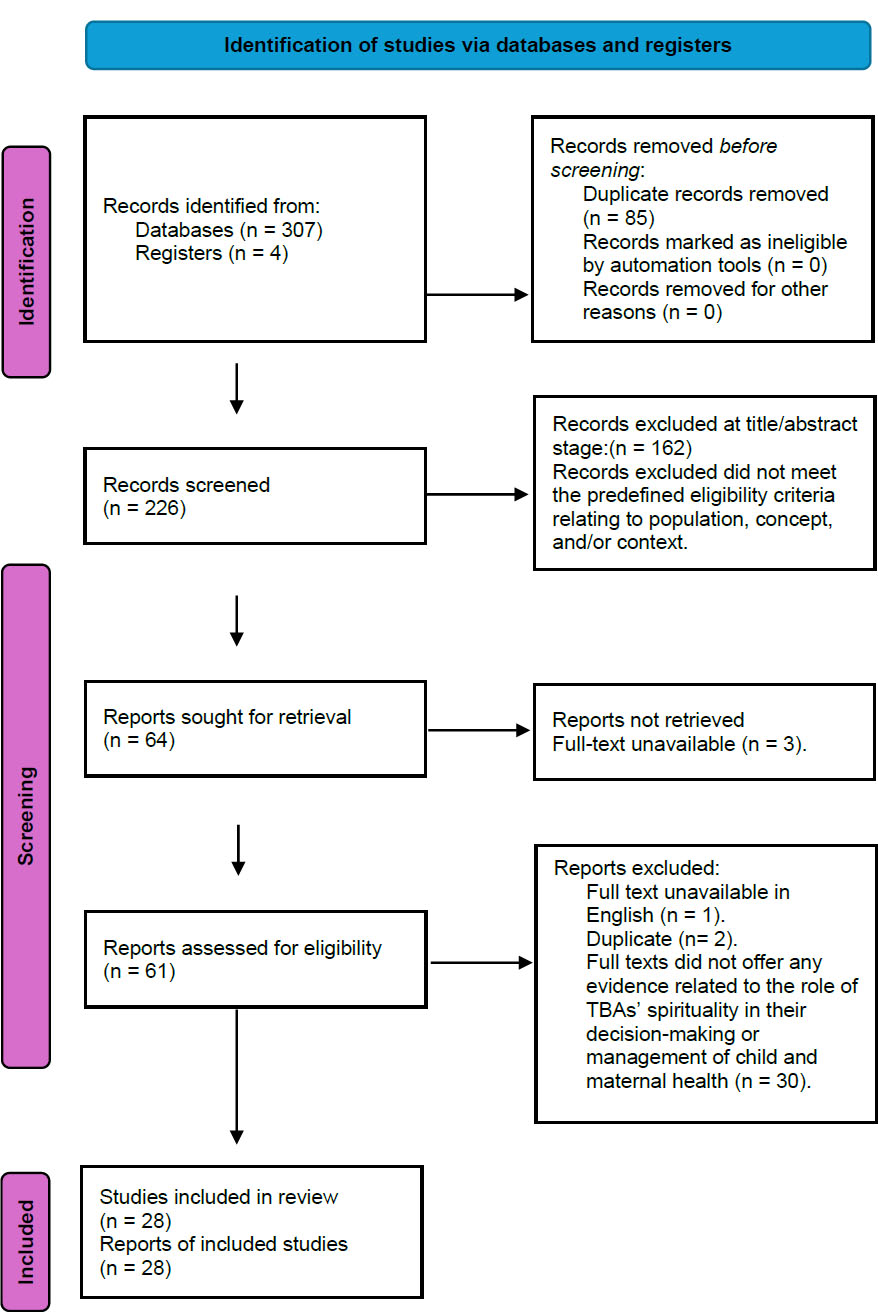
Flow diagram depicting the study selection process.
3.2. Characteristics of Sources of Evidence
The 28 data sources selected comprised 22 (78.6%) peer-reviewed research articles, 3 (10.7%) peer-reviewed theoretical papers, 1 (3.6%) doctoral dissertation, and 2 (7.1%) midwifery magazine articles (Table 4). Although not initially identified as meeting the inclusion criteria, the midwifery magazine articles were selected for the rich data they offered, in line with the review topic, and were classified as grey literature. Qualitative study designs accounted for the overwhelming majority, with 19 studies (67,9%), while there were 3 (10,7%) mixed-methods studies, 1 (3.6%) evidence synthesis, and zero quantitative studies. This is unsurprising due to the nature of the review topic. Study methods varied, with case studies, ethnography, phenomenology, and narrative inquiry as the dominant methods. Data were mostly collected through interviews and focus groups. Lastly, only 9 (32.1%) of the selected articles investigated the role of spirituality within TBAs’ management of child and maternal health broadly. The remaining 19 (67.8%) investigated the TBAs’ role(s), knowledge, and management of a specific aspect, period, and/or condition within child and maternal health. Therefore, articles that mentioned TBAs' spirituality and described its influence on TBAs' decisions and/or health management practices in these conditions were included.
| Data Source | Study [Reference no.] | Study Design. | Study Method. | Population Characteristics |
Child and maternal health condition(s) investigated |
|---|---|---|---|---|---|
| Peer reviewed research article. |
[32] | Ǫualitative descriptive | In depth interviews | Sage/experienced TBA (n=1) | Early breastfeeding initiation. |
| Peer reviewed research article. |
[18] | Mixed-Methods | Cross-sectional. | TBAs (n = 163) | Prematurely erupted teeth of infants. |
| Magazine (Midwifery Today) |
[34] | Personal Narrative | Pregnancy and Childbirth. |
||
| Peer reviewed research article. |
[29] | Ǫualitative | Cooperative Inquiry | Midwife/academics (n=11) | Pregnancy and Childbirth. |
| Peer reviewed research article. |
[38] | Ǫualitative descriptive | Focus group | Child-bearing women (n=12) TBA (n = 4) Spiritual birth attendants (n=4) |
Pregnancy and Childbirth. |
| Peer reviewed theoretical paper. |
[24] | Theoretical paper: Why Restoring Birth as Ceremony Can Promote Health Equity in Latinx and indigenous communities. |
Pregnancy and Childbirth. |
||
| Peer reviewed theoretical paper |
[44] | Theoretical paper: The midwife as healer. | Midwifery/TBA practice | ||
| Peer reviewed research article. |
[20] | Mixed Methods | In depth interviews | Women who had given birth at local birthing centres (n=12) TBAs (n = 36) staff members: educators, nurses, and professional midwives (n=18). |
Pregnancy and Childbirth. |
| Magazine (Midwifery Today) |
[25] | Reflective piece | Midwifery/TBA practice | ||
| Peer reviewed theoretical paper. |
[17] | Theoretical paper: overview picture of the health practices and beliefs affecting childbearing and the traditional midwifery care in Zimbabwe |
Pregnancy and Childbirth. |
||
| Peer reviewed research article. |
[35] | Ǫualitative descriptive | Hermeneutic phenomenology |
Skilled midwives (n = 4) TBAs (n=10) postpartum mothers (n=7) |
Pregnancy and Childbirth. |
| Peer reviewed research article. |
[21] | Ǫualitative exploratory | Appreciative Inquiry | Midwives (n = 10) TBAs (n= 4) Indigenous knowledge holders (n= 6) |
Indigenous placenta disposal. |
| Peer reviewed research article. |
[39] | Ǫualitative | Case Study | Service users (n = 2) TBAs (n = 4) Primary healthcare workers (n=2) |
Pregnancy and Childbirth. |
| Peer reviewed research article. | [23] | Ǫualitative | Ethnography | TBAs (n=10) | Midwifery/TBA practice |
| Peer reviewed research article. |
[27] | Ǫualitative | Case study | TBA (n=1) Nurse (n = 1) Women in the community (n=2) |
Reproductive impropriety. |
| Peer reviewed research article. |
[43] | Ǫualitative descriptive | focus groups, in-depth interviews, field notes, and observations. |
pregnant women (n=116) western midwives (n=13) TBAs (n=12) |
Midwifery/TBA practice |
| Peer reviewed research article. |
[22] | Literature Review: Evidence Synthesis | Midwifery/TBA practice | ||
| Peer reviewed research article. |
[42] | Ǫualitative | Hermeneutic phenomenology. |
midwives (n = 7) TBA (n = 5), |
Pregnancy and Childbirth. |
| Peer reviewed research article. |
[33] | Ǫualitative | Narrative Inquiry | TBA (n= 1) | Midwifery/TBA practice |
| Peer reviewed research article. |
[31] | Ǫualitative | Case Study | TBAs (n=3) | Family planning. |
| Peer reviewed research article. |
[19] | Ǫualitative exploratory | In-depth individual interviews |
TBAs (n= 16) | Pregnancy and Childbirth. |
| Peer reviewed research article. |
[40] | Ǫualitative descriptive | Focus Groups | Indigenous women of reproductive age (n=44) TBAs (n =6) |
Pregnancy and Childbirth. |
| Peer reviewed research article. |
[28] | Ǫualitative descriptive | Interviews | Doulas (n=15) | Pregnancy and Childbirth. |
| Peer reviewed research article. |
[36] | Ǫualitative descriptive | Interviews | Women of reproductive age (n = 60) Elder influential women (n = 60) TBA (n= 60) Village doctor (n=60) |
Pregnancy and Childbirth. |
| Peer reviewed research article. |
[37] | Mixed- Methods | Hospital records and Focus groups. |
TBAs (n = 71) | Midwifery/TBA practice |
| Peer reviewed research article. |
[41] | Ǫualitative exploratory. | Cross-sectional. | TBAs, (n =10) Herbalists (n =10) Spiritualists (n= 10) |
Midwifery/TBA practice |
| Peer reviewed research article. | [30] | Ǫualitative | Indigenous research methods | Indigenous doula (n = 5) | Midwifery/TBA practice |
| Doctoral Dissertation | [26] | Ǫualitative | Ethnography | Pregnant women (n =28) Nurse midwives (n=5) Public health workers (n =5) TBAs (n=27) |
Pregnancy and Childbirth. |
3.3. Results of Individual Sources of Evidence
Data were extracted on the following: i) author and year of publication, ii) location of the study, iii) study design, iv) study methods, v) terminology used to refer to TBAs, vi) TBAs' gender, vii) definition(s) of spirituality, viii) key decisions, and ix) health management practices (Appendix 1). These results are synthesized and presented below.
3.4. Synthesis of Results
3.4.1. Geographic Location
The majority of the data sources emanated from the Global South (n=22), with only 6 from the Global North (Table 5).
| Country | No of Studies |
Study. [Reference no.] |
|---|---|---|
| Nigeria | 4 | [18, 39, 40, 42] |
| Zimbabwe | 3 | [17, 32, 38] |
| Ghana | 3 | [19, 31, 41] |
| South Africa | 1 | [21] |
| Mexico | 1 | [22] |
| Haiti | 2 | [35, 37] |
| Guatemala | 2 | [20, 23] |
| Belize | 2 | [26, 27] |
| Indonesia | 2 | [25, 33] |
| Malaysia | 1 | [43] |
| Bangladesh | 1 | [36] |
| United States of America | 2 | [24, 34] |
| United Kingdom | 2 | [44, 29] |
| Canada | 1 | [30] |
| Switzerland | 1 | [28] |
3.4.2. Terminology
The terminology used to describe traditional birth attendants varies across regions and is impacted by language, culture, and their role within child and maternal health. Traditional birth attendants were also referred to as ‘traditional midwives’ [17-21], ‘lay midwives’ [22], ‘indigenous midwives’ [23, 24], ‘village midwives’ [25], ‘bush doctors’ [26, 27], ‘doulas’ [28, 29], ‘indigenous doulas’ [30], ‘community health workers’ [31], ‘sages’ [32], or ‘birth activists’ [29] and were distinguished from ‘trained’ or ‘skilled’ birth attendants and midwives, who were formally trained and practiced within modern healthcare facilities [33-37]. Bartlett [34] distinguished between ‘tribal midwifery’ and ‘spiritual midwifery’, noting a distinction between collective, traditional practices and those that honored the spiritual dimensions of pregnancy and childbirth. This found synergy with Crowther et al.’s [29] framing of ‘spiritual midwifery’, which emphasizes the relational and existential significance of pregnancy and childbirth. Dodzo and Mhloyi [38] considered ‘community birth attendants’ (CBAs), comprising two groups: TBAs, whose practices were informed by cultural beliefs, and ‘spiritual birth attendants’, whose practices were guided by their religion.
3.4.3. TBAs and Gender
The results showed that TBAs in 21 of the studies (75%) were women. Men were found to be represented in only 2 (7%) studies [19, 26]. 7 studies (25%) did not mention the gender of the TBAs who participated in the study [18, 21, 24, 29, 37, 39, 40]; however, because the studies used female pronouns to refer to the TBAs, it is assumed they were women. Further to this, TBAs were generally inducted into their role by an older, female relative in the family or community [17, 19, 22]. By virtue of this cross-generational induction process, women found overwhelming representation as TBAs. It is interesting to note that in some studies, TBAs were framed as operating in an ‘indigenous/traditional system of maternity care’ [26, 41] or ‘birthing communities’ [34]. These were a collection of communities of ‘traditional practitioners’ [41] comprised of TBAs, healers, herbalists, and spiritual/traditional leaders that were consulted and sought out for their indigenous cultural, traditional, and spiritual knowledge for both physical and spiritual ailments. In these birthing ecologies or communities, women predominantly occupied the position of traditional birth attendant, which, outside of facilitating spiritual/traditional health management practices, included support with the practicalities of pregnancy and birth, and the day-to-day running of the home [35, 37]. In contrast, men who formed part of these indigenous systems of maternity care took responsibility for the more ‘authoritative’, instructive and consultative roles, such as ‘village doctors’ [36], ‘traditional paediatricians’ [17], ‘indigenous knowledge holders’ [21], and ‘spiritualists and herbalists’ [41]. Further to this, in some contexts men are considered responsible for their children’s spiritual and moral upbringing [17].
3.4.4. Definitions of Spirituality within the Data
Despite discussing the role of spirituality in TBA’s decision-making and health management of pregnancy and childbirth, the construct remained largely undefined in the chosen data sources. Only 2 studies (7.1%) offered definitions of spirituality within their articles. Crowther et al. [29] defined spirituality as “…an aspect of our lives that brings meaning, sense of purpose, unifies our life narrative, feelings of interconnectivity and of deepening relationships with self and others (‘others’ being seen and unseen). It may be connected to religion and also a belief in a quality of divinity, but not necessarily. Spirituality is part of our wellbeing and includes psychological, emotional and cultural aspects of being and becoming”. For Ohaja et al. [42] spirituality referred to “…a way of being, a quest for ‘meaning and purpose of life”. Interestingly, in some sources, spirituality was used interchangeably with religion, positioning spiritual power(s) and the sacredness of life as foundational to both religion and spirituality [29, 33, 39, 42]. Maraesa [26] notes that within Mayan spirituality, many of the sacred practices combine and blend with Catholicism. For the Igbo people of Nigeria, ‘traditional religion’ was a term used to refer to rituals and sacred myths practiced within Igbo culture that include the worship of God, “non-spirits”, and ancestors [42]. Mutambirwa [17], although not defining spirituality, describes the human spirit as “the eternal element of mankind’s constitution”, positioning spirituality as the core essence of human life.
3.4.5. The Role of Spirituality in TBAs’ Health Management and Decision-making within Child and Maternal Health
Spirituality played a foundational and core role in TBAs’ health management practices and decision-making within child and maternal health. This was consistently expressed within the evidence and is detailed according to three themes, namely:
- Becoming a TBA: A spiritual calling.
- TBAs as traditional and spiritual companions and advocates during pregnancy and childbirth.
- Spirituality at the core of TBA decision-making and health management: Challenges in context.
3.4.5.1. Becoming a TBA: A Spiritual Calling
The process of becoming a TBA was described in the data sources as both a calling and a gift from the creator, God and/or the ancestors [20, 23, 24, 35, 38]. The decision to ‘heed’ this calling and become a TBA was therefore seen as a holy and deeply spiritual commitment. Although the process of becoming a TBA varied across data sources, a commonality was the process’s spiritual and metaphysical properties. Some were ‘called’ via ancestral and divine selection through dreams [19, 23, 33], and others through spiritual intuition and divination [31, 40, 42]. In addition to this, some were approached and selected for apprenticeship by older TBAs, who were often female family members or close friends [25, 31, 22, 25, 31]. This framing supported TBAs view that they embody ways of knowing and caring that reflect a culture of spirituality, one that values existential, emotional, and traditional understandings of spirituality [21, 29, 32]. Further to this, TBAs were regarded as ‘spiritual leaders’ [40] who were ‘spiritually mature’ members of the community [17]. This gave them the spiritual authority and the required spiritual powers and ancestral knowledge to welcome in new life [22, 25, 33, 40]. From this spiritual/religious lens, TBAs were seen as the guardians of the sacred birth space [29] who were called to offer holistic ‘religio-spiritual care’ [39], that is, care that is holistic, indigenous, and reflects strong spiritually protective elements against supernatural forces [19, 21, 25, 27-30, 33, 34, 40, 42].
3.4.5.2. TBAs as Traditional and Spiritual Companions and Advocates during Pregnancy and Childbirth
Further to the above, TBAs described their role as that of facilitating the sacred process of bringing life into this earth [34], and to protect and ensure the continuance of traditional pregnancy and birth practices [43]. This was achieved through a process described as ‘accompagnateur [accompaniment]’ and is described as “…an approach for working with, supporting, and providing needed services to historically marginalized or vulnerable groups. It involves multiple stakeholders going through an experience together in solidarity to achieve a shared goal, ensuring that the vulnerable do not bear the load alone” [37]. This evidence positions the TBA as a trusted confidant, companion, guide, and advocate for pregnant and birthing mothers [20, 28-30, 34, 37, 39]. In addition, TBAs saw their work as being in consultation with the sacred [34], that is, based on godly principles, and reflects the intention to preserve the mothers' life and spiritual integrity through application of their spiritual knowledge and powers and facilitation of spiritual rituals [18, 19, 22, 23, 29, 30, 33-35, 38, 42].
Despite their practice being framed within health, TBAs do not consider their clients “unwell” [44], and therefore saw themselves as responsible for creating caring and nourishing spaces that honored the sacred and relational element of birth, connecting TBAs, mothers and families as human beings within their cultural/ traditional/indigenous ecosystem [24, 29, 42, 43]. TBAs health management of child and maternal health was therefore seen as extending beyond the pregnant woman and her family’s pregnancy and childbirth health needs to include spiritual health advocacy [35, 40], community support, and community development work [25, 33, 35]. In the context of child and maternal heath, this spiritual grounding meant that complications during pregnancy and childbirth, and any illnesses or developmental delays experienced within the post-partum period, were perceived from a spiritual rather than biological basis [38], and seen as evidence of immoral or spiritual transgressions and/or ill-wishes [17, 19], maternal sin, such as maternal witchcraft, theft or promiscuity [26, 27, 32], and/or evils spirits [18, 36, 42].
3.4.5.3. Spirituality at the Core of TBA Decision-making and Health Management: Challenges in Context
TBAs’ spiritual grounding was central to their decision-making and health management practices within child and maternal health. Even so, TBAs generally offered their services in contexts that undermined their contribution [17, 29], saw TBAs spirituality and customs as outdated [24, 43], prioritized biomedical framings of health [24, 44], and reflected high rates of poverty, poor infrastructure, limited access to resources and quality, and culturally competent healthcare [22, 24, 25, 35, 37, 41]. The evidence shows that TBAs’ spirituality-based services intersected with these contextual challenges and created complexities that significantly impacted/influenced their decision-making and their selection and facilitation of traditional health management practices. The supporting evidence is presented below.
3.4.6. Decision-Making
TBAs navigated multiple key decisions when offering their services to pregnant women and their families. A key decision that emerged from the evidence was the decision to accept the pregnant woman as a client or to refer to ‘formal’ health facilities [18, 19, 33, 38, 39]. This decision was impacted by several factors, such as the women’s stage of pregnancy when seeking TBA services, with late applicants often being referred to clinics out of fear of bad luck, evil spirits and death [38]. Other factors were the high demand for TBAs [39], the pregnant women’s diagnosis with a traditional or spiritual disease [17, 31, 33], and the accessibility and availability of maternal healthcare facilities [25]. In Lievense et al. [34], TBAs and health professionals from formal health facilities collaborated to offer pregnancy and birth services from ‘local birthing centres’ that mirrored traditional home-birthing environments and were located within indigenous communities, negating the need for referral through collaboration within the community. Interestingly, in Agwu et al. [39], TBAs were suspected of delaying referral to health facilities and accused of retaining clients longer than what was thought of as necessary or safe, to increase their earnings. A facility manager in the study shared that, “They [TBAs] keep trying and trying, even when they know it is beyond them. They just want to take money from her [pregnant woman] or her husband”
Another key decision was whether to attend to a birthing mother alone, in pairs, or in teams or collectives. TBAs who took the decision to draw on support from other TBAs did so where and when possible, as this provided emotional and practical support for both the TBA and the birthing woman [17, 26, 30, 34, 35]. In addition, TBAs would call on others to assist with infrastructure constraints such as available and accessible transport [37].
Lastly, the evidence showed that deciding whether to charge for one’s services was a key decision and point of contention, as TBAs were often not formally employed, and some, due to the spiritual nature of their work, did not believe that they should charge for their services [35, 38]. Those who did charge for their services allowed women to pay according to what and when they could afford [33], or alternatively ‘pay’ using a gesture or symbol of goodwill [40], such as a chicken [17]. TBAs felt they could not refuse a client for inability to pay a certain amount, as they were practicing a gift from God who valued generosity [33, 40], and that they would receive ‘payment’ or compensation from the divine in the form of blessings [37]. At times, TBAs had to pay for transport to health facilities using their own funds and would borrow money from community members if they could not pay at the time [37].
3.4.7. Health Management
Similarly, TBAs health management of child and maternal health, demanded the facilitation of traditional/spiritual healing practices and/or rituals to ensure the health and safety of the mother and child [26, 29] and to protect, cleanse and restore the spiritual and moral integrity of the pregnant or birthing mother, and by extension, the family and community, “Preparations[health management practices] included ritual cleansing and removing spells on any immoral behavior committed by either the pregnant woman herself or her biological family members” [32]. These practices were spiritually rooted and culturally/traditionally informed and are presented in Table 3. TBA spirituality not only informs the type of health management practices TBAs facilitated, but also equipped them with the spiritual knowledge and ‘cultural competence’ [21] to ensure sensitivity to and alignment with culturally appropriate maternal and child healthcare [31]. In addition, the evidence shows that some of these spiritually based health management practices were at times in opposition to those recommended by healthcare facilities, fuelling tensions between Western and traditional care [26, 43, 41].
4. DISCUSSION
4.1. Summary of Evidence
The evidence shows that TBAs' spirituality is at the core of their decision-making and health management practices within child and maternal health. This centrality revealed itself in the decision to and process of becoming a TBA, which was framed as a ‘calling’ and an invitation or instruction from God, ancestors, or spirits to protect the sacredness of birth according to traditional customs, rituals and practices. Further to this, spirituality shapes TBAs’ understanding of their role, which requires them to recognize each birthing experience as unique and therefore remain flexible in their role(s), decisions, and approaches to child and maternal health while prioritizing the safety of the mother and child.
The evidence also shows that contextual constraints and support both influenced TBAs’ decision-making, despite these decisions being spiritually informed and rooted. TBAs had to make several key decisions when delivering their services. These key decisions included whether and when to refer to health facilities, whether to offer their services as individuals or with varying levels of community support, and whether to charge for their services. These choices revealed tensions between TBAs and modern health facilities, highlighting further contextual constraints that affected their decisions. Lastly, spirituality was identified as the core determinant influencing their selection and facilitation of health management practices evidenced in the literature, including birth and delivery, massage, prayer, rituals, the administration of herbal medicine, home maintenance, teaching, counseling, community support and development, and fasting.
Key groups that may benefit from this evidence include health systems developers, policy makers, health practitioners (both traditional and modern), health educators, health economists, community development staff and health and social science researchers. Each of these groups forms an integral part of the health system and should therefore center the sacred nature of pregnancy and birth, as well as the role, experiences, and perspectives of TBAs as informed by their spirituality within context. Specifically, these groups should prioritize these themes as priority research areas within maternal and child health.
4.2. Limitations
Despite spirituality’s foundational role, described above, of concern is the absence of a clear definition of spirituality across 26 of the included studies. While we accept that interpretations of spirituality are context-specific and multidimensional, this limited the comparability of findings and introduced challenges for synthesis. A lack of a shared definition of spirituality meant that studies may have been examining related, but not identical, phenomena. Therefore, the results mapped should be read with the acknowledgement that spirituality remains an ambiguous concept without a singular, universally understood definition. To support interpretation of this conceptual ambiguity, the review adopted a working definition of spirituality as ‘a connection to the Divine, self, and Others’. This facilitated the identification of common conceptual threads, while preserving the original meanings attributed to spirituality within individual studies.
Another key limitation of the scoping review process was that only English language articles were selected. This limited the identification of relevant studies in indigenous languages, thereby increasing the risk of both language and geographical bias. Further to this, the scoping review method is limited in its ability to provide depth about the complex role of spirituality and its expression and constraints within various contexts, and its intersections with other aspects of identity.
CONCLUSION
The available evidence supports the notion of spirituality as both central and essential to TBAs decision-making and health management practices within child and maternal health. TBAs' spirituality both informed their decision to heed the call to serve and informed their initiation and ‘training’ process. In addition, TBAs spirituality guided, informed and facilitated a range of decisions and health management practices within the services they offered. Even so, TBAs remain minimally recognized for their contribution to the continuity of cultural, traditional and indigenous pregnancy and birth care. Further to this, despite the value of TBAs’ spiritually rooted services, definitions of spirituality within the available literature remain vague, limiting a comprehensive understanding of and engagement with the topic. Lastly, the foundational role of spirituality informing TBAs initiation, decision-making, and health management practices remains minimally explored from the perspective of TBAs, warranting further studies that clearly define spirituality and center first-person narrative accounts of TBAs’ experiences as informed by their spirituality, and impacted by contextual limitations and supports.
AUTHORS’ CONTRIBUTIONS
The authors confirm their contributions to the paper as follows: M.S.M. and C.O.: Study conception and design; M.S.M. and C.O.: Data collection and analysis; M.S.M. and C.O.: Interpretation of results; and M.S.M.: Draft manuscript. Both authors reviewed the results and approved the final version of the manuscript.
LIST OF ABBREVIATIONS
| TBA | = Traditional Birth Attendants |
| MMR | = Maternal Mortality Rate |
| PRISMA | = Preferred Reporting Items for Systematic Reviews and Meta-Analysis |
AVAILABILITY OF DATA AND MATERIALS
All the data and supporting material are available within the article.
FUNDING
Subcommittee A Project Funding, Faculty of Economic and Management Sciences, Stellenbosch University. The funders did not have any role in the topic selection, study design, data collection or reporting.
ACKNOWLEDGEMENTS
Stellenbosch University Libraries, specifically Mr YR and Mr JM.