All published articles of this journal are available on ScienceDirect.

Bridging the Rehabilitation Gap: A Prospective Interventional Study of Multimodal AI-based Wearable Stimulation in Subacute Stroke Patients

Abstract
Introduction/Objective
After discharge, many stroke patients are still in a period of active neural recovery. However, the amount of supervised rehabilitation usually decreases once they return home. This mismatch between ongoing brain plasticity and reduced therapy may affect upper limb recovery. This study examined whether a movement-responsive wearable stimulation system used at home is related to differences in upper limb motor recovery compared with usual home-based rehabilitation.
Methods
A prospective controlled study was conducted with 351 patients in the subacute stage after stroke. Participants were randomly allocated using a computer-generated sequence to either a wearable stimulation group (n = 176) or a conventional home rehabilitation group (n = 175). Upper limb motor function was assessed using the Fugl-Meyer Assessment-Upper Extremity (FMA-UE) at discharge (T0), 1 month (T1), and 3 months (T2).
Results
FMA-UE scores increased over time in both groups. However, the pattern of change differed between groups (group × time interaction, F = 28.34, p < .001). At 3 months, the mean FMA-UE score was 58.2 ± 7.5 in the wearable group and 46.1 ± 9.2 in the control group. Within the wearable group, higher device use was associated with greater motor improvement (r = 0.72). The between-group difference at 3 months corresponded to a large effect size (Cohen’s d = 1.4).
Discussion
These findings suggest that movement-contingent stimulation may support motor recovery by providing feedback aligned with voluntary effort during daily activities. This approach may help sustain engagement during the post-discharge period when supervised therapy is reduced.
Conclusion
Use of a movement-responsive wearable stimulation system during home-based rehabilitation was associated with improved upper limb motor recovery during the subacute stage after stroke.
1. INTRODUCTION
Persistent motor impairment after stroke remains common despite improvements in acute survival rates [1-3]. Recovery patterns differ widely, particularly in relation to upper limb function. Difficulty using the affected arm interferes not only with basic daily activities but also with participation in social and occupational roles [2, 4]. For this reason, structured rehabilitation is typically initiated early in the course of care. The weeks and months following medical stabilization are often described as a period during which the nervous system remains responsive to training input [5]. Functional gains observed during this interval are not identical to those seen later in the chronic phase [6, 7]. Repetition and task-specific practice appear to influence how movement patterns reorganize [8]. Yet, the conditions under which such practice occurs frequently change once hospital-based therapy concludes.
Discharge commonly takes place before full motor recovery has been achieved [9, 10]. After returning home, therapy intensity often decreases, and patients are expected to continue exercises independently [11]. In practice, adherence varies. Some individuals maintain regular practice; others reduce activity as daily routines resume. Reduced engagement of the affected limb may contribute to compensatory strategies that persist over time. As a result, a discrepancy can emerge between recommended rehabilitation intensity and what is feasible in community settings [12, 13]. Various technological approaches have been introduced to supplement home rehabilitation [13, 14]. Wearable stimulation systems are intended to facilitate muscle activation and encourage repeated movement. Many earlier designs deliver stimulation irrespective of voluntary effort, operating in an open-loop configuration [15]. When peripheral input is not temporally aligned with motor intention, its influence on relearning processes may be limited.
Closed-loop systems attempt to address this issue by detecting movement-related signals and delivering stimulation only when active effort is identified [14, 15]. Advances in wearable sensing technologies, including inertial and electromyographic signal monitoring, have made it possible to implement such approaches outside specialized clinical environments [13]. Whether movement-contingent stimulation during the subacute stage after discharge is associated with differences in motor recovery compared with standard home instruction remains to be clarified. The present study explores this question in discharged stroke patients during the early recovery period. Closed-loop stimulation is thought to enhance motor relearning by synchronizing peripheral input with voluntary motor intention. This temporal coupling may facilitate activity-dependent plasticity and strengthen sensorimotor integration. Unlike conventional open-loop systems, the present device delivers stimulation only when movement-related signals are detected, allowing more task-relevant feedback during rehabilitation.
2. MATERIALS and METHODS
2.1. Study Design and Ethical Considerations
This investigation was carried out at three rehabilitation centers between October 2024 and October 2025. Participants were observed for three months following enrollment. Clinical evaluations were conducted by assessors who did not take part in treatment delivery. The protocol was reviewed and approved by the Institutional Review Board of the affiliated institution (IRB No. MEDR147). Written consent was obtained prior to participation. When communication was limited due to stroke-related deficits, consent procedures were completed with legally authorized representatives.
2.2. Participants
A total of 351 individuals in the recovery phase after stroke were included. Enrollment was limited to patients with a first unilateral ischemic or hemorrhagic event confirmed by imaging. At study entry, the time since onset ranged from one to three months. All participants had been discharged to home settings and demonstrated mild to moderate upper limb impairment, defined by FMA-UE scores between 15 and 55. Cognitive capacity sufficient to understand study procedures was required, reflected by Mini-Mental State Examination scores of at least 24. Patients were not enrolled if other neurological or orthopedic conditions could interfere with upper limb assessment. Additional reasons for exclusion included marked spasticity (Modified Ashworth Scale >3), implanted electronic medical devices, or skin conditions preventing electrode placement.
2.3. Allocation and Blinding
Baseline assessments were completed prior to group assignment. Allocation to the wearable intervention group (n = 176) or comparison group (n = 175) followed a computer-generated sequence prepared before recruitment began. Group assignments were revealed only after baseline measurements had been recorded. Because the intervention involved a visible device, participants were aware of their assignment. Outcome assessments, however, were conducted by occupational therapists who were not informed of group allocation.
2.4. Intervention
2.4.1. Wearable Stimulation Group
Participants assigned to the intervention received a wearable stimulation unit upon discharge. The device was positioned on the affected forearm, with electrodes placed over extensor muscle groups responsible for wrist and finger extension, including the extensor digitorum communis and extensor carpi radialis. The system incorporated motion sensing and surface electromyographic monitoring. Movement-related signals were processed continuously. When voluntary activation met predefined thresholds, electrical stimulation was triggered to assist the attempted movement. During the initial fitting, stimulation parameters were adjusted individually to ensure comfort and effective activation. Participants were instructed to use the device for approximately one hour daily over a 12-week period. Rather than restricting use to structured exercise sessions, integration into routine activities was encouraged.
The wearable system operates in a closed-loop manner. Motion signals from the inertial sensor and surface electromyography are continuously analyzed in real time. Electrical stimulation is delivered only when voluntary movement attempts are detected and exceed predefined activation thresholds. This design allows temporal coupling between motor intention and peripheral stimulation.
Stimulation was delivered at a frequency of 30 Hz, with a pulse width of 250 μs. The amplitude ranged from 10 to 30 mA and was adjusted individually to produce visible muscle contraction without discomfort.
2.4.2. Comparison Group
Participants in the comparison group received discharge guidance consistent with routine practice. Written materials described range-of-motion and strengthening exercises for the upper limb. These exercises were similar to those introduced during inpatient rehabilitation. Individuals were advised to continue practice at home for about 60 minutes each day for 12 weeks. No stimulation device or sensor-based feedback system was provided.
2.5. Outcome Measures
Assessments were conducted at three time points: at discharge (T0), one month (T1), and three months (T2). Upper limb motor function was evaluated using the Fugl-Meyer Assessment-Upper Extremity (FMA-UE), scored from 0 to 66. Change in score across visits was considered the primary indicator of motor recovery. Functional independence was measured with the Modified Barthel Index (MBI), which ranges from 0 to 100 and reflects performance in daily self-care activities. Health status from the participant’s perspective was recorded using the EuroQol-5 Dimension (EQ-5D-5L). Adherence was tracked using different approaches. In the wearable group, duration of use and stimulation events were stored automatically by the device. Participants in the comparison group recorded their exercise activity in written logs.
2.6. Statistical Analysis
The target sample size was estimated before recruitment began. Calculations suggested that approximately 300 participants would allow detection of modest group differences over time with 80% statistical power at a 5% alpha level. Effect sizes were calculated using Cohen’s d. Ninety-five percent confidence intervals were also estimated. To account for possible dropout, enrollment exceeded this minimum. Analyses were conducted using SPSS software (version 28.0; IBM Corp., Armonk, NY, USA). Baseline characteristics were compared between groups using independent t-tests for continuous data and chi-square tests for categorical variables. Changes in outcomes across the three assessments were examined using repeated-measures models. Group was treated as the between-subject factor and time as the within-subject factor. The interaction between group and time was used to assess whether patterns of change differed across conditions. A p-value below 0.05 was considered statistically significant.
3. RESULTS
3.1. Participant Characteristics
Among 410 individuals screened at discharge, 351 fulfilled eligibility requirements and consented to participate. Fifty-nine were not enrolled because of exclusion criteria or personal decision. Group assignment resulted in 176 participants in the wearable intervention group and 175 in the comparison group. The screening and allocation process is illustrated in Fig. (1). Baseline demographic and clinical profiles were similar across groups. Age, sex distribution, BMI, affected side, cognitive function (MMSE), time since stroke onset, and initial FMA-UE scores did not differ statistically between groups (all p > 0.05). Detailed baseline information is provided in Table 1.
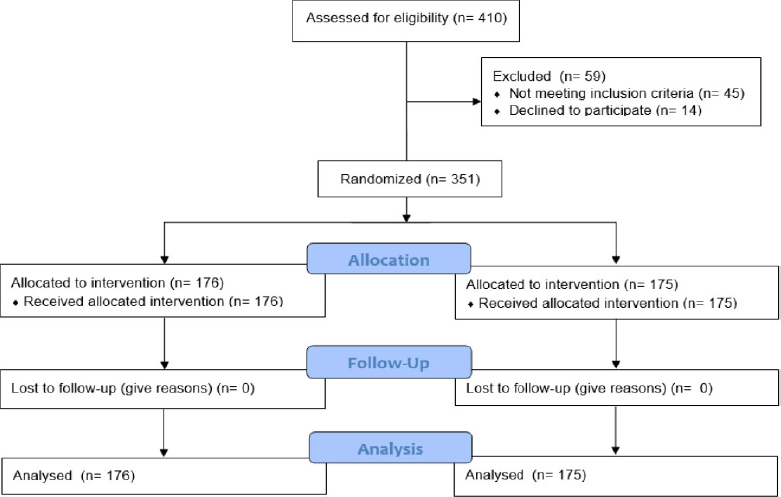
Participant flow from screening to follow-up.
| Variables | Total (N=351) | Exp. Group (n=176) | Cont. Group (n=175) | p-value |
|---|---|---|---|---|
| Age (years), Mean | 68.4 ± 9.2 | 68.1 ± 8.9 | 68.7 ± 9.5 | 0.542 |
| Sex (male) | 185 (52.7%) | 93 (52.8%) | 92 (52.6%) | 0.981 |
| BMI (kg/m2) | 24.1 ± 3.2 | 24.0 ± 3.1 | 24.2 ± 3.3 | 0.672 |
| Time since Stroke (days) | 52.3 ± 14.8 | 51.6 ± 14.2 | 53.0 ± 15.3 | 0.210 |
| Stroke Type | - | - | - | 0.844 |
| Ischemic | 247 (70.4%) | 123 (69.9%) | 124 (70.9%) | - |
| Hemorrhagic | 104 (29.6%) | 53 (30.1%) | 51 (29.1%) | - |
| Affected side (Right) | 182 (51.9%) | 91 (51.7%) | 91 (52.0%) | 0.954 |
| MMSE score | 26.8 ± 1.9 | 26.7 ± 1.8 | 26.9 ± 2.0 | 0.441 |
| Baseline FMA-UE Score | 32.5 ± 8.4 | 32.1 ± 8.2 | 32.9 ± 8.6 | 0.385 |
Note: Values are presented as mean ± standard deviation (SD) or number (%). BMI: body mass index; MMSE: Mini-Mental State Examination; FMA-UE: Fugl-Meyer Assessment-Upper Extremity.
3.2. Motor Performance and Functional Outcomes
Upper limb motor scores changed across follow-up in both groups. Patterns of change, however, were not identical. Repeated-measures analysis identified a significant interaction between group and time (F = 28.34, p < 0.001). Between one and three months, improvement appeared to slow in the comparison group, while the intervention group continued to show progressive gains. At the three-month assessment, mean FMA-UE values were 58.2 ± 7.5 in the intervention group and 46.1 ± 9.2 in the comparison group. The difference between groups at this point reached statistical significance (p < 0.001). Detailed outcome data are presented in Table 2. Changes in FMA-UE scores over time are shown in Fig. (2A), whereas changes in MBI scores are presented in Fig. (2B). Activities of daily living demonstrated a similar directional pattern. MBI scores increased during follow-up, with a significant group-by-time interaction (F = 15.67, p < 0.001). At three months, the intervention group recorded a mean score of 92.1 compared with 79.5 in the comparison group. Quality-of-life scores also improved over time. Between-group differences were smaller in magnitude than those observed for motor performance but reached statistical significance at follow-up (p < 0.05). The mean difference in FMA-UE at 3 months was 12.1 points (95% CI: 10.2-14.0). All outcome values are summarized in Table 2.
| Variable | Group | Baseline (T0) | 1 Month (T1) | 3 Months (T2) | Mean Diff (T2) | 95% CI | Effect Size | F (Interaction) |
|---|---|---|---|---|---|---|---|---|
| FMA-UE | Exp. | 32.1 ± 8.2 | 45.3 ± 9.1 | 58.2 ± 7.5 | 12.1 | 10.2-14.0 | d=1.40 | 28.34** |
| (Motor) | Cont. | 32.9 ± 8.6 | 38.5 ± 8.8 | 46.1 ± 9.2 | - | - | - | - |
| MBI | Exp. | 65.2 ± 10.5 | 78.4 ± 11.2 | 92.1 ± 8.4 | 8.12 | 9.8-15.4 | d=1.20 | 15.67* |
| (ADL) | Cont. | 64.8 ± 10.1 | 70.1 ± 10.8 | 79.5 ± 11.5 | - | - | - | - |
Note: Exp = intervention group; Cont = comparison group; CI: confidence interval. Values are presented as mean ± standard deviation (SD). Mean Diff (T2): between-group difference at 3 months (Exp - Cont). Effect size calculated using Cohen’s d. F values represent the group x time interaction obtained from repeated-measures ANOVA. *p < .05; ** p < .001.
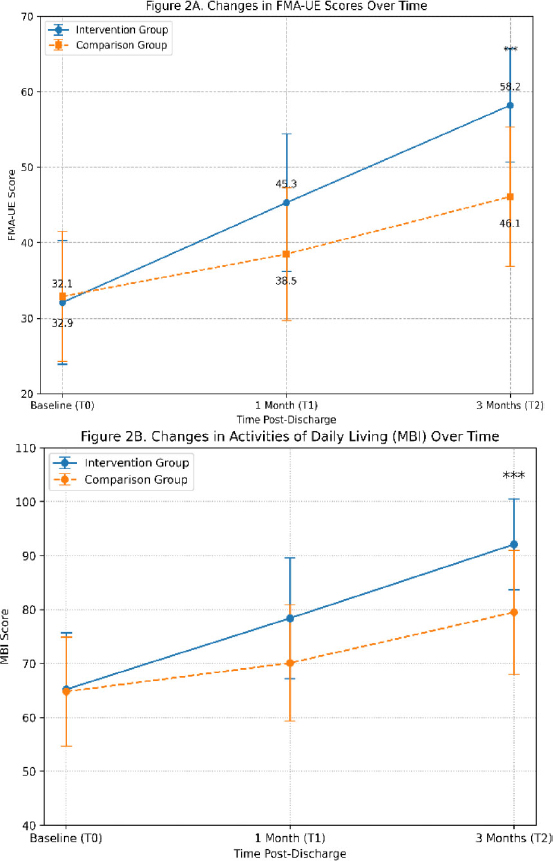
Changes in motor function and functional independence.
(2A) presents FMA-UE scores measured at discharge (T0), 1 month (T1), and 3 months (T2). (2B) presents Modified Barthel Index (MBI) scores measured at the same assessment points. Values are expressed as mean ± standard deviation (SD). Dashed gridlines are shown for visual reference. **p < 0.001 for the between-group comparison at 3 months.
3.3. Association between Device Use and Motor Recovery
Within the wearable group, variation in recorded device use was examined in relation to motor change over three months. Compliance reflected the proportion of activation events triggered during valid movement attempts. Motor improvement was expressed as the difference in FMA-UE score between discharge and the three-month assessment. A positive association was observed between recorded device use and change in FMA-UE score (r = 0.72, p < 0.001). Individuals with higher activation rates generally showed larger increases in motor performance. The distribution of this relationship is presented in Fig. (3).
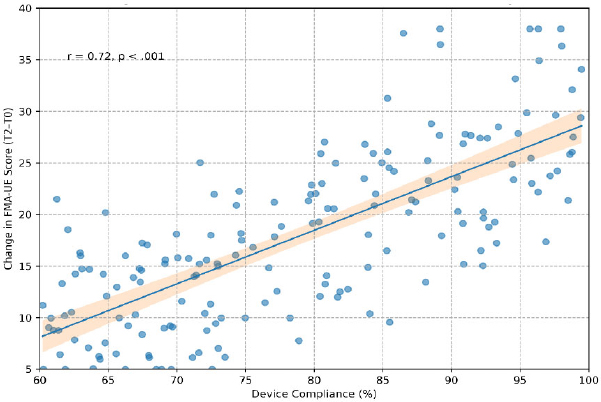
Association between device use and motor recovery.
4. DISCUSSION
The weeks following discharge often introduce a shift in how rehabilitation is experienced. During inpatient care, repetition is structured, supervised, and externally regulated. Once at home, the same level of intensity is difficult to maintain. Neurological recovery, however, does not pause at discharge [16]. The early post-stroke period continues to be characterized by adaptive processes that may respond to practice input [17]. The contrast between ongoing biological responsiveness and reduced therapeutic structure raises practical questions about how recovery environments shape functional change.
Home exercise programs depend heavily on self-management. Motivation, daily routine, fatigue, and family support all influence how frequently prescribed exercises are performed. Prior work has noted that adherence may decline when repetition lacks variation or external reinforcement [18]. In this context, movement-contingent assistance introduces a different form of engagement. Rather than providing stimulation continuously, the system responds only when voluntary effort is detected. This conditional activation changes the temporal pattern of feedback and may influence how movements are repeated and perceived [19].
The association between recorded device use and motor change adds nuance to this interpretation. Rehabilitation outcomes are not determined solely by duration of practice [20]. The quality of repetition-its timing, attentional demands, and contextual integration-also plays a role. When assistance occurs during an intentional movement attempt, repetition may be more closely linked to goal-directed activity. Although direct neural mechanisms were not examined, the observed pattern aligns with conceptual models emphasizing contingent feedback in motor relearning [21]. One possible explanation is that movement-contingent stimulation enhances sensorimotor coupling by reinforcing motor cortex activation during voluntary effort. This timing-dependent feedback may support activity-dependent plasticity and improve motor relearning.
It is also important to consider that behavioral factors can influence engagement. The presence of monitoring may alter routine behavior. Participants aware of device recording may interact differently with the intervention. In addition, the social environment at home varies widely. Caregiver involvement, encouragement, and logistical support may shape daily activity patterns. Such contextual differences are rarely uniform across participants and may contribute to variability in outcome trajectories [22].
The broader context of stroke rehabilitation further frames these findings. Discontinuity between hospital-based therapy and community follow-up has been described as a persistent structural challenge. Access to outpatient or community rehabilitation services varies across regions, and extended inpatient stays are often limited by resource allocation [23]. Evidence suggests that home-based rehabilitation can be as effective as center-based programs when adequate intensity and guidance are maintained [24]. In this context, technology-supported approaches may represent one method of sustaining structured engagement when direct supervision decreases. Their role, however, should be viewed as complementary rather than substitutive, given the multidimensional needs of stroke survivors.
Interpretation remains cautious. Observational associations cannot establish causal pathways. Variability in adherence measurement methods between groups and differences in personal circumstances may have influenced the results. Follow-up was confined to the early recovery window, and trajectories beyond this period remain uncertain. Longer observation would clarify whether early differences narrow, persist, or evolve as recovery stabilizes.
5. LIMITATIONS
Several aspects of the study design should be considered. Participants knew which group they were assigned to, and this awareness may have influenced how they engaged with the program. In behavioral rehabilitation research, separating intervention effects from motivational factors is not straightforward. Adherence was captured differently in each group. Device activity was recorded automatically in the intervention group, whereas participants in the comparison group documented their exercises in written logs. These approaches are not directly equivalent and may have affected how engagement was represented. Follow-up covered only the first three months after discharge. Changes observed during this stage may not reflect longer-term patterns. In addition, the analysis focused on functional scores and recorded device activity. Factors such as ease of use in home environments, caregiver support, and the day-to-day demands of managing equipment were not examined in detail. These practical considerations may influence how similar systems perform outside controlled study settings.
CONCLUSION
The use of a movement-responsive wearable system during the early months after discharge was associated with differences in motor and functional outcomes compared with standard home guidance. Structured, effort-contingent feedback may help sustain engagement during a period when supervised therapy decreases. How such approaches perform over longer periods and across varied home contexts remains to be clarified.
AUTHOR’S CONTRIBUTIONS
The author confirms contribution to the paper as follows: K.SH.: Conceived and designed the study, conducted data collection and analysis, interpreted the findings, and prepared the manuscript. The author reviewed and approved the final version for submission.
LIST OF ABBREVIATIONS
| ADL | = Activities of Daily Living |
| ECR | = Extensor Carpi Radialis |
| EDC | = Extensor Digitorum Communis |
| EQ-5D | = EuroQol-5 Dimension |
| FES | = Functional Electrical Stimulation |
| FMA-UE | = Fugl-Meyer Assessment-Upper Extremity |
| IMU | = Inertial Measurement Unit |
| MBI | = Modified Barthel Index |
| sEMG | = Surface Electromyography |
ETHICS APPROVAL AND CONSENT TO PARTICIPATE
Ethical approval was obtained from the Institutional Review Board of the affiliated institution (Approval Date: October 2024).
HUMAN AND ANIMAL RIGHTS
All human research procedures followed were in accordance with the ethical standards of the committee responsible for human experimentation (institutional and national), and with the Helsinki Declaration of 1975, as revised in 2013.
CONSENT FOR PUBLICATION
Participation was voluntary, and written consent was secured prior to study procedures. When communication limitations were present due to stroke-related impairments, consent was provided by legally authorized representatives. Data were coded prior to analysis, and identifying information was removed to protect participant confidentiality.
AVAILABILITY OF DATA AND MATERIALS
All the data and supporting material is available within the article.
ACKNOWLEDGEMENTS
Declared none.