All published articles of this journal are available on ScienceDirect.

Health-related Quality of Life and its associated Factors among Indonesian Prolanis Patients with Type 2 Diabetes Mellitus in Community Pharmacies: A Cross-sectional Study
 iD
Neily Zakiyah2 , 4
iD
Niken Indriyanti5
iD
Keri Lestari2 , 4
iD
iD
Neily Zakiyah2 , 4
iD
Niken Indriyanti5
iD
Keri Lestari2 , 4
iD
Authors Info & Affiliations
Abstract
Introduction
Type 2 diabetes mellitus (T2DM) continues to pose a significant public health burden in Indonesia and is widely managed through the Program Pengelolaan Penyakit Kronis (Prolanis) in primary healthcare settings. Nevertheless, research evaluating health-related quality of life (HRQoL), especially within community pharmacy practice, is still limited. This study was conducted to evaluate HRQoL and its associated factors among Prolanis patients with T2DM attending community pharmacies in Indonesia.
Methods
An analytical cross-sectional study was carried out among Prolanis patients with T2DM who received services at two community pharmacies belonging to a national pharmacy chain in Bandung (West Java) and Samarinda (East Kalimantan) from September 2023 to February 2024. HRQoL was evaluated using the EuroQol five-dimension five-level (EQ-5D-5L) questionnaire. Data on the sociodemographic, clinical, and healthcare-related characteristics were obtained through interviews and medical record reviews. Both bivariate and multivariable linear regression analyses were conducted to determine the factors associated with HRQoL.
Results
The study included 102 participants. The average EQ-5D utility score was 0.79 ± 0.15, and the median EQ-VAS score was 70 (IQR 65–80). A lower HRQoL was independently associated with advanced age (p = 0.008), female gender (p = 0.034), a longer duration of diabetes (p = 0.005), and the presence of diabetes-related complications (p = 0.002). In contrast, regular pharmacy counseling showed a positive association with HRQoL (p = 0.019). No statistically significant relationship was identified between HbA1c levels and HRQoL following multivariable adjustment.
Discussion
HRQoL among Prolanis patients with T2DM was influenced by sociodemographic, clinical, and healthcare-related factors, highlighting the importance of patient-centered diabetes care in community pharmacy settings.
Conclusion
HRQoL among Prolanis patients with T2DM in community pharmacy settings was associated with several sociodemographic, clinical, and healthcare-related factors. Routine pharmacy counseling may contribute to improved patient-reported outcomes in diabetes care.
1. INTRODUCTION
As a significant global public health concern, type 2 diabetes mellitus (T2DM) is linked to significant morbidity, long-term consequences, and higher healthcare utilization [1, 2]. Beyond its clinical ramifications, type 2 diabetes has a substantial impact on patients' physical, psychological, and social well-being, highlighting the significance of assessing outcomes that represent patients' perceptions of their health condition, including health-related quality of life (HRQoL) [3, 4]. Diabetes is becoming more common worldwide, especially in low- and middle-income nations where health systems struggle to provide long-term, patient-centered care [5]. The prevalence of diabetes and related risk factors is rising in Indonesia, according to national data, underscoring the need to improve chronic disease management at the basic healthcare level [6].
In response to the increasing burden of T2DM, Indonesia has implemented structured chronic disease management initiatives within primary healthcare, including the Program Pengelolaan Penyakit Kronis (Prolanis) [7]. However, evaluations of such programs have largely focused on clinical indicators and healthcare utilization, which may provide an incomplete assessment of chronic disease management outcomes because patient-reported outcomes such as HRQoL are often underrepresented in routine evaluations [8, 9].
HRQoL is commonly assessed using standardized instruments such as the EuroQol five-dimension questionnaire (EQ-5D), which enables the evaluation of health status across multiple domains and the derivation of a single utility score for population health assessment [10]. The use of the EuroQol five-dimension five-level (EQ-5D-5L) Indonesian value set also allows for a more context-specific evaluation of patient-reported outcomes in Indonesian populations. Community pharmacies play an increasingly important role in the delivery of primary healthcare services for patients with chronic diseases. As highly accessible points of care, community pharmacies routinely provide medication counseling and ongoing support for patients with T2DM as part of their usual care [11, 12]. Nevertheless, the evidence on HRQoL among Prolanis patients has predominantly originated from Puskesmas or hospital-based settings, resulting in a limited understanding of HRQoL outcomes within community pharmacy contexts.
Much of the existing literature has focused on structured or enhanced pharmacist-led interventions, while relatively little attention has been paid to the usual pharmacy counseling delivered as part of routine practice [11, 12]. In addition, studies evaluating HRQoL among Prolanis patients across geographically distinct regions in Indonesia remain limited. Consequently, real-world evidence regarding the factors associated with HRQoL among Prolanis patients receiving routine pharmacy services remains limited. Thus, this study sought to examine HRQoL and its associated factors among Prolanis patients with T2DM in Indonesian community pharmacies.
2. METHODS
2.1. Study Design and Setting
This analytical cross-sectional study was carried out at Kimia Farma community pharmacies in Region 2 (Bandung, West Java) and Region 3 (Samarinda, East Kalimantan), Indonesia. These sites were purposively selected to represent differences in urban characteristics and healthcare contexts between Java and non-Java regions, as well as the availability of routine pharmacist counseling services for patients with type 2 diabetes mellitus. The data were collected at a single time point between September 2023 and February 2024, reflecting real-world primary healthcare practice in community pharmacy settings.
2.2. Study Population and Sampling
The study population comprised Prolanis patients with T2DM who received services at the participating community pharmacies. The participants were enrolled through purposive sampling, in which individuals fulfilling the predefined eligibility criteria were intentionally selected during the study period to ensure alignment with the study objectives and sufficient exposure to routine community pharmacy care. Due to feasibility considerations within real-world community pharmacy settings, all eligible patients available during the study period were invited to participate. Because the study was exploratory in nature, a formal sample size calculation was not conducted.
Eligible participants included adults aged 18 years or older with a confirmed diagnosis of T2DM who were registered with the Prolanis program, able to communicate effectively, complete the questionnaire, and provide written informed consent. Patients with severe cognitive impairment, major communication difficulties, or incomplete HRQoL data were excluded. During the study period, 128 patients were assessed for eligibility, of whom 102 fulfilled the inclusion criteria and completed the study questionnaires, resulting in a response rate of 79.7%.
2.3. Pharmacy Counseling (Usual Care)
Pharmacy counseling refers to the routine counseling practices already being provided by pharmacists in the participating community pharmacies before the implementation of the study intervention. The counseling was neither standardized nor modified by the research team and generally included medication use instructions, adherence support, and brief lifestyle advice as part of usual care. The frequency of counseling varied depending on routine pharmacy practice and patient visits.
2.4. Outcome Measure
The EQ-5D-5L questionnaire, a standardized tool that assesses perceived health in five domains (mobility, self-care, typical activities, pain/discomfort, and anxiety/ depression), was used to assess HRQoL [13]. The Indonesian EQ-5D-5L tariff developed by Purba FD et al. was then used to convert the participants' responses into a utility value. Utility values can vary from a maximum score of 1, which indicates optimal health status, to negative ratings, which signify health issues deemed worse than death. The EQ-5D utility index was regarded as the main HRQoL outcome in this study [10]. Additionally, the participants were asked to rate their general health on the EQ visual analogue scale (EQ-VAS), which has a score range of 0 to 100, with higher scores denoting greater perceived health.
2.5. Independent Variables
The independent variables included sociodemographic characteristics (age, sex, education level, and occupation), clinical characteristics (duration of diabetes, hemoglobin A1c (HbA1c) level, and presence of diabetes-related complications), and healthcare-related factors, specifically the receipt of pharmacy counseling as part of routine care.
2.6. Data Collection Procedure
The data collection was carried out through face-to-face interviews administered by trained research staff using a structured questionnaire at a single point in time. Sociodemographic information was obtained through patient self-reporting, while clinical data, including HbA1c levels and diabetes-related complications, were extracted from the most recent pharmacy or medical records available. To ensure participant confidentiality, all collected data were anonymized prior to the analysis.
2.7. Statistical Analysis
The HRQoL results and participant characteristics were summarized using descriptive statistics. Continuous variables were displayed as mean ± standard deviation or median with an interquartile range. Depending on the data distribution, categorical data were represented as frequencies and percentages. The Shapiro-Wilk test was used to determine whether the continuous variables were normally distributed. One-way analysis of variance (ANOVA), independent t-tests, or appropriate non-parametric tests when parametric assumptions were not met were used to examine the bivariate relationships between the independent factors and HRQoL. To identify the factors independently linked to HRQoL, variables with p-values of less than 0.25 in the bivariate analyses were added to a multivariable linear regression model. β coefficients and 95% confidence intervals (95% CI) were used to express the regression results. Statistical significance was defined as a p-value of less than 0.05. SPSS Statistics version 31.0 (IBM Corp., Armonk, NY, USA) was used for the statistical analysis.
3. RESULTS
Figure 1 illustrates the participant recruitment and selection process. The final analysis included 102 Prolanis patients with T2DM. Table 1 presents the clinical and sociodemographic characteristics of the participants.
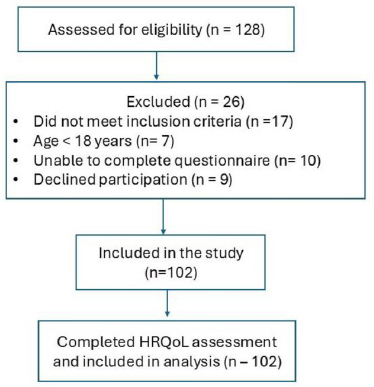
Participant flow diagram.
| Characteristic | Value |
|---|---|
| Age (years) | 56.8 ± 8.9 |
| Sex | |
| Male | 35 (34.3) |
| Female | 67 (65.7) |
| Education level | |
| Primary or lower | 32 (31.8) |
| Secondary | 46 (45.5) |
| Higher | 24 (22.7) |
| Duration of diabetes (years) | |
| < 5 years | 37 (36.4) |
| ≥ 5 years | 65 (63.6) |
| Presence of complications | 72 (65.5) |
| Type of antidiabetic therapy | |
| Oral antidiabetic drugs | 69 (67.3) |
| Insulin ± OAD | 33 (32.7) |
| Received pharmacy counseling (last 3 months) | 85 (77.3) |
| HbA1c | |
| > 8% | 85 (83.3%) |
| ≤ 8% | 17 (16.7%) |
Note: Data is presented as mean ± SD or n (%), as appropriate.
The majority of participants in this study were middle-aged to older persons, with a high percentage of females, and most had had diabetes for at least five years. The majority of participants received pharmacist counseling as part of normal care, and over half reported at least one diabetes-related problem. Oral antidiabetic medication was the primary treatment for the majority of individuals. Table 2 displays the distribution of HRQoL scores among the research participants. The EQ-5D index score and EQ-VAS were used to measure HRQoL and characterize general health. According to the EQ-5D utility scores and EQ-VAS, individuals generally reported moderate HRQoL levels. Pain/discomfort and anxiety/depression issues were more frequently mentioned among the EQ-5D dimensions than restrictions related to mobility, self-care, and regular activities.
| HRQoL Measure | Mean ± SD | Median (IQR) |
|---|---|---|
| EQ-5D index score | 0.79 ± 0.15 | 0.81 (0.72–0.89) |
| EQ-VAS score | 71.4 ± 12.6 | 70 (65–80) |
Note: Data is presented as mean ± SD or median (IQR), as appropriate.
Table 3 presents the results of the multivariable linear regression analysis of the factors associated with HRQoL. Several sociodemographic and clinical factors were independently associated with EQ-5D utility scores.
| Variable | β (95% CI) | p-value |
|---|---|---|
| Age ≥60 years | −0.058 (−0.101 to −0.015) | 0.008* |
| Female sex | −0.042 (−0.081 to −0.003) | 0.034* |
| Duration of diabetes >5 years | −0.061 (−0.103 to −0.019) | 0.005* |
| HbA1c >8% | −0.029 (−0.071 to 0.013) | 0.176 |
| Presence of complications | −0.094 (−0.152 to −0.036) | 0.002* |
| Received pharmacy counseling (yes) | +0.047 (0.008 to 0.086) | 0.019* |
Notes: β = regression coefficient; CI = confidence interval. *p < 0.05.
4. DISCUSSION
Multivariable analysis indicated that older age, female sex, a longer duration of diabetes, and the presence of diabetes-related complications were independently associated with lower HRQoL scores, while the receipt of routine pharmacy counseling was positively associated with HRQoL. These findings suggest that HRQoL among patients with T2DM reflects a complex interaction of sociodemographic, clinical, and healthcare-related factors rather than glycemic control alone [1, 4, 8].
This study contributes to the limited evidence regarding HRQoL among Prolanis patients with T2DM in Indonesian community pharmacy settings. Unlike many previous studies that primarily focused on clinical outcomes or structured pharmacist-led interventions, this study evaluated HRQoL and its associated factors within routine community pharmacy practice, reflecting real-world patient care. In addition, the inclusion of participants from two geographically distinct regions in Indonesia provides broader insight into HRQoL among patients receiving chronic disease management services in different healthcare contexts.
The overall HRQoL levels in this study were moderate, with pain/discomfort and anxiety/depression being the most frequently reported problems. Similar patterns have been observed in population-based studies, indicating that diabetes imposes substantial physical and psychological burdens that are not fully captured by biomedical indicators [1, 3, 8]. These domains may reflect the chronic symptom burden, emotional stress, and treatment-related challenges commonly experienced by patients with long-standing T2DM.
Consistent with previous studies, older age and a longer duration of diabetes were associated with lower HRQoL, likely due to the cumulative disease burden, functional decline, and increasing treatment complexity [3, 8, 14]. The negative association observed between female sex and HRQoL aligns with prior evidence showing greater psychosocial distress and symptom burden among women with T2DM [4].
The presence of diabetes-related complications was significantly associated with poorer HRQoL, supporting evidence that both microvascular and macrovascular complications substantially impair patients’ perceived health status and daily functioning [1, 15]. These findings underscore the importance of complication prevention and early management within primary healthcare programs for diabetes.
Routine pharmacy counseling was positively associated with HRQoL. Although causality cannot be inferred from this cross-sectional study, previous evidence indicates that community pharmacy services, including medication counseling and adherence support, are associated with improvements in patient-reported outcomes and perceived well-being among individuals with chronic diseases [11, 12, 16, 17]. Pharmacist counseling may also support patients’ self-management behaviors and confidence in managing long-term therapy [16, 17]. These findings support the integration of community pharmacies as accessible components of primary healthcare delivery.
In contrast, HbA1c level was not independently associated with HRQoL after adjustment for other factors. This finding is consistent with studies indicating that glycemic control alone does not adequately reflect patients’ lived experiences of diabetes [18, 19]. HRQoL is a multidimensional construct influenced not only by glycemic control but also by psychological adaptation, treatment burden, social support, disease duration, the presence of complications, and patients’ perceptions of their health condition [14, 20]. Some individuals with suboptimal HbA1c levels may still report acceptable HRQoL due to successful adaptation to chronic illness and preserved daily functioning [3, 21, 22]. Therefore, glycemic indicators alone may not fully capture patients’ subjective health experiences [14, 23].
Recent studies have highlighted the importance of patient-reported outcomes, including HRQoL, in the evaluation of diabetes management programs and primary healthcare services [8, 23, 24]. Community pharmacy-based services have also been increasingly recognized as accessible and practical approaches to improving medication adherence, supporting self-management, and delivering patient-centered care among individuals with T2DM [11, 12, 23].
Several recent studies have reported that older age, a longer duration of diabetes, and diabetes-related complications are consistently associated with poorer HRQoL among patients with T2DM [14, 22]. In addition, pharmacist counseling and community-based diabetes support services have been associated with improved patient satisfaction, self-care behaviors, and HRQoL among patients with chronic diseases [16, 23, 24]. Therefore, HRQoL provides complementary information to clinical indicators in the evaluation of chronic disease management.
When interpreting the findings, several limitations of this study should be considered. First, the cross-sectional design precludes conclusions regarding causal relationships. Second, HRQoL outcomes and exposure to pharmacy counseling were assessed using self-reported measures, which may be subject to recall bias. Furthermore, the study employed purposive sampling and was limited to two community pharmacies within a single national pharmacy chain, potentially limiting the external validity and representativeness of the findings for other Prolanis and primary healthcare settings in Indonesia. The exploratory nature of the study and the relatively small sample size may also limit the generalizability of the findings. In addition, the limited sample size may have affected the stability and robustness of the multivariable regression model despite efforts to minimize overfitting through selective variable inclusion. Therefore, the regression findings should be interpreted with caution.
CONCLUSION
According to this study, sociodemographic, clinical, and healthcare-related characteristics are linked to HRQoL among Prolanis patients with T2DM in community pharmacy settings. The results indicate that routine pharmacy counseling may support more patient-centered diabetes treatment and emphasize the significance of including patient-reported outcomes in the assessment of primary healthcare services. To validate these correlations and guide service improvement, more research employing longitudinal or interventional methods is necessary.
AUTHORS’ CONTRIBUTIONS
The authors confirm contribution to the paper as follows: D.R.: Conceived and designed the study, collected and analyzed the data, and prepared the initial manuscript draft; N.Z.: Provided subject-matter expertise and assisted in revising the manuscript; N.I.: Contributed to the methodological guidance and interpretation of the findings; K.L.: Provided overall conceptual supervision and critically reviewed the manuscript. All authors reviewed and approved the final version of the manuscript.
LIST OF ABBREVIATIONS
| T2DM | = Type 2 Diabetes Mellitus |
| HRQoL | = Health-Related Quality of Life |
| EQ-5D-5L | = Euroqol Five-Dimension Five-Level |
| ANOVA | = Analysis of Variance |
ETHICS APPROVAL AND CONSENT TO PARTICIPATE
The study protocol was approved by the Health Research Ethics Committee, Faculty of Medicine, Universitas Padjadjaran, Bandung, Indonesia (No. 862/UN6.KEP/EC/2023).
HUMAN AND ANIMAL RIGHTS
All human research procedures followed were in accordance with the ethical standards of the committee responsible for human experimentation (institutional and national), and with the Helsinki Declaration of 1975, as revised in 2013.
CONSENT FOR PUBLICATION
Written informed consent was obtained from all participants aged 18 years or older for the publication of their anonymized data in this manuscript.
AVAILABILITY OF THE DATA AND MATERIALS
The data generated and analyzed in this study is not publicly available due to ethical and confidentiality restrictions but may be obtained from the corresponding author [D.R] upon reasonable request.
FUNDING
This study did not receive any specific funding. The research was conducted as part of the authors’ institutional duties at the Faculty of Pharmacy, Universitas, Padjadjaran, Indonesia.
ACKNOWLEDGEMENTS
The authors would like to express their sincere gratitude to the participating pharmacy chain branches in Bandung and Samarinda for permitting this study to be conducted. The authors also thank all participants for their valuable contribution to this research. English language editing for this manuscript was provided by proofers (proofers.co.uk).